Warning to Restoration Contractors and Roofers: The Old Way of Doing Business is Over.

On August 3, 2017, the 2nd District Court of Appeals in Fort Worth granted class certification against Lon Smith Roofing (LSRC), a prominent North Texas Roofer, for violation of the Texas Public Insurance Adjusting Act. Given the direction the courts in North Texas have gone in the past few years, the ruling is not a surprise. It is a warning to restoration contractors in general, and roofers in particular, that the old way of doing business is over. Contractors that negotiate with, or even represent themselves as able and willing to negotiate with, insurance adjusters do so at their own peril. (read more)

By way of background, in September 2013, the Keys sued LSRC asking the court to declare their contract void and to order the return – to them – of all monies their insurance company paid to the roofer. It’s important to remember that this is not a lawsuit about whether the roof was properly or timely installed. The roof doesn’t leak, the color isn’t wrong, the roofer didn’t damage the driveway or flower beds, or fail to respond to warranty claims. This lawsuit, which is a continuation of a dispute that started in 2011, is about language that, until recently, was commonly found in roofing contracts throughout the state of Texas.  Language that I still routinely see in roofing contracts today.

The Keys asked the 236th District Court in Tarrant County to approve them to act as representative plaintiffs in a class action lawsuit against LSRC. On October 15, 2015, the district court judge signed an order granting the class certification. That order was immediately appealed. Last week, after almost two years, the appellate court issued its ruling upholding the class certification on the Keys’ claim for the “return” of all monies paid to the roofer as part of their declaratory judgment claim (violation of Public Insurance Adjuster’s Statute/Insurance Code 4102) and the DTPA claim that provides for the potential for treble damages for violation of Texas Insurance Code 541 (unfair methods of competition and unfair or deceptive acts or practices). Class certification was denied for the DTPA claim for unconscionability.

The appellate court’s decision can, and likely will, be appealed to the Texas Supreme Court, who can choose to review that ruling, or to leave it undisturbed. In the meanwhile, the ruling upholding class certification is a further step in the continuum of cases favoring consumers to the detriment of restoration contractors. In discussing the facts supporting its decision to uphold the class certification, the court cited to testimony from Mr. Keys that the roofer “never told him that he could or should get a public insurance adjuster involved in his roof-damage claim under his homeowners’ policy” and that the homeowner “understood that [Roofer] was contracting to discuss his insurance claim with his insurer and was also contracting to repair his roof.“

Some groups are claiming this as a victory for consumers. Whatever your perspective on this issue, what is clear is that lawsuits claiming violations of the Public Insurance Adjuster (PIA) law have just been given a big boost via class certification.

What does mean for those of you working in the restoration contracting community? First, what happened to this roofer could have happened to any number of other roofers using the same or similar language in their contracts. Or any roofer negotiating claims with insurance adjusters. The ability to initiate class action lawsuits will embolden plaintiff’s attorneys to pursue similar claims against restoration contractors and roofers since they’ll only have to prove the representative plaintiff’s claim rather than the claims of every plaintiff taking part in the class action suit (one plaintiff – multiple verdicts). The cost to defend against a lawsuit of this type, win or lose, is extremely expensive. Further, if you lose, you not only have to write a check to the property owner for anything paid to you by them or their insurance company, sometimes tripled depending on whether the violation is determined to be knowing or intentional, you’ll also have to pay their legal fees, which will almost certainly greatly exceed the cost of the roof, to potentially every owner you sold for the last ten years (the span of the Keys/LSRC class action certification).

What should you do? Make sure your contract doesn’t contain any of the language the courts have determined violates the PIA statute. Include language in your contracts that specifically puts the owner on notice that you are not offering to and will not provide any PIA services. Don’t hold yourself out as an insurance expert. Understand and be ready to educate owners about their rights and options for dealing with insurance adjusters (attorney, appraisal, public insurance adjuster), making referrals where appropriate to ethical attorneys, appraisers, and public insurance adjusters who can advocate for the homeowner without taking away your sale. Restrict your conversations with insurance adjusters to answering questions regarding your scope and price – don’t negotiate the claim with the insurance adjuster.

Karen, you say, you don’t know what it’s like out in the real world. But I do understand, including that the majority of “negotiations” are initiated by the insurance adjuster. However, this PIA law isn’t going away. Instead, it is being vigorously and strictly enforced in the courts and by TDI, and the ramifications to your business cannot be ignored.

SWB Wins Insurance Coverage for Clients in Federal Court

insurance-policy-and-gavel

Congratulations to our firm’s clients, Phil and Susan Swartztrauber, for winning a court order obtaining insurance coverage against Travelers Casualty and Surety Company of America.

The case was handled by Alex Beard.  The Swartztraubers were board members of their Home Owners Association (HOA), and were sued for alleged defamation in an underlying suit filed by the HOA’s President.  Travelers insured the HOA, but refused to provide the Swartztraubers with a defense to the defamation suit.

U.S. District Judge David Hittner disagreed, and ruled that Travelers breached its policy contract, and violated the Texas Prompt Payment Statute, by failing to provide the Swartztraubers with a defense.  So, Travelers will have to pay for the defense, legal fees and costs of the coverage case, as well as the underlying lawsuit.

Great work, Alex!


Notice of Nonsuit – An Order is Necessary

Although a Motion for Nonsuit or a Notice of Nonsuit is effective immediately upon filing, there must still be an order formally dismissing the case.  Texas Rule of Civil Procedure 162 reads as follows:

At any time before the plaintiff has introduced all of his evidence other than rebuttal evidence, the plaintiff may dismiss a case, or take a non-suit, which shall be entered in the minutes. Notice of the dismissal or non-suit shall be served in accordance with Rule 21 a on any party who has answered or has been served with process without necessity of court order. Any dismissal pursuant to this rule shall not prejudice the right of an adverse party to be heard on a pending claim for affirmative relief or excuse the payment of all costs taxed by the clerk.  A dismissal under this rule shall have no effect on any motion for sanctions, attorney’s fees or other costs, pending at the time of dismissal, as determined by the court. Any dismissal pursuant to this rule which terminates the case shall authorize the clerk to tax court costs against dismissing party unless otherwise ordered by the court.

The phrase “without necessity of court order” does not mean that an order formally dismissing the case is not necessary.  The Supreme Court of Texas sets forth a particularly good reason why an order is necessary:

The nonsuit extinguishes a case or controversy from the moment the motion is filed or an oral motion is made in open court; the only requirement is the mere filing of the motion with the clerk of the court.[1]

However, the signing of an order dismissing a case, not the filing of a notice of nonsuit, is the starting point for determining when a trial court’s plenary power expires. Appellate timetables do not run from the date a nonsuit is filed, but rather from the date the trial court signs an order of dismissal.[2]

An order is necessary in order to establish appellate deadlines.  In addition, a deadline needs to be established for the court’s plenary powers in light of the balance of Rule 162, which specifically allows the trial court to assess sanctions, attorneys’ fees, and costs after the nonsuit is taken.

The necessity of an order is further reinforced when taking into consideration bogus counterclaims for declaratory relief.  In some cases, a defendant may have good reason to dispute a nonsuit, especially if res judicata may prevent future lawsuits.  In such instances, although a nonsuit has been filed, the trial court will need to determine whether a counterclaim exists that prevents the dismissal of the case as a whole.[3]

If you have anything to add to the topic, please leave a comment in the section below.

[1] Univ. of Tex. Med. Branch at Galveston v. Estate of Blackmon, 195 S.W.3d 98, 100 (Tex. 2006).

[2] In re Bennett, 960 S.W.2d 35, 38 (Tex. 1997).

[3] See BHP Petroleum Co. v. Millard, 800 S.W.2d 838 (Tex. 1990).

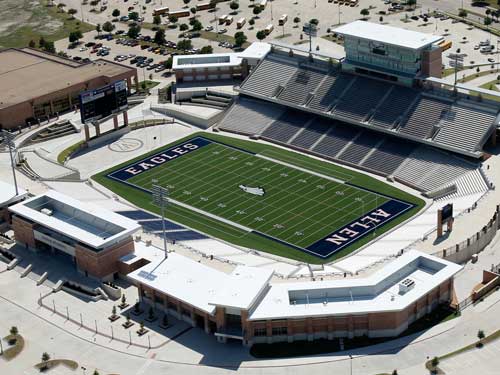
The Eagle Has Landed

AISD

There is nothing like Fall football, especially in Texas.  As a native Texan, one of my favorite sayings is “everything is bigger and better in Texas.” The Allen football stadium is no exception.

Last year, deficiencies were discovered that resulted in the closure of Allen’s $60 million Eagle Stadium.  Since that time, Mark Walsh, a founding partner of Saunders Walsh & Beard, has been working with AISD, Pogue Construction, and PBK Architects to diagnose, engineer, and create a long term solution to the issues. Implementing that solution, and getting it paid for by the original designers and builders (without litigation) required an aggressive and complex legal strategy, coupled with the cooperation of all parties.

Congratulations to Allen Independent School District, Superintendent Dr. Lance Hindt, and Mark Walsh for developing and executing the legal strategy that got the stadium repaired, losses covered, all expenses paid, and the team back in their Stadium!

For details of the settlement reached, check out the articles below:

http://starlocalmedia.com/allenamerican/news/allen-isd-reaches-m-settlement-for-stadium-repairs/article_e4f5d636-a36f-11e5-ab36-63701a5b5de2.html

http://allenblog.dallasnews.com/2015/12/allen-isd-to-receive-1-7-million-settlement-related-to-stadium-problems.html/