A trusted business law firm in McKinney, TX.

Blog

Blog

The Difference between a Rule of Interpretation and a Canon of Construction

One evening, sitting by the fireplace, sipping on a cup of hot coco, I found myself musing on the subject of contract interpretation.  I was pondering various active cases and my fading memory of my first year of law school when I had two revelations:  1) I am getting old, and 2) I had no idea if “construe against the grantor” was a rule or a canon.  I suspected that I was not the first attorney to have this particular question, so I became determined to find the answer and share it with you.

            I suspected that the two phrases were interchangeable.  It did not take much research to determine that most practicing attorneys think they are interchangeable, many appellate courts use the terms interchangeably, and the phrases are, in fact, NOT interchangeable.  The rules of contract interpretation are used to determine a contract’s meaning, to determine the parties’ respective rights and obligations, and to make the determination as to whether the contract is ambiguous.[1]  The canons of construction are utilized to resolve irreconcilable ambiguities in the words of a contract once the actual intent of the parties thereto proves indecipherable.[2]  In other words, if a contract is unambiguous, thus a question of law for the court’s determination, the court may utilize the rules of interpretation.  Should the contract prove to be ambiguous, the next step is to apply the canons of construction.

            If you are still a bit confused, I have compiled some examples for your reading pleasure:

Rules of Interpretation:

  1. Construe the agreement as a whole;
  2. Give each word and phrase its plain, grammatical meaning unless it definitely appears that such meaning would defeat the parties’ intent;
  3. Construe the agreement, if possible, so as to give each provision meaning and purpose so that no provision is rendered meaningless or moot;
  4. Express terms are favored over implied terms or subsequent conduct; and
  5. Surrounding circumstances may be considered – not to determine a party’s subjective intent – but to determine the appropriate meaning to ascribe to the language chosen by the parties.[3]

Canons of Construction:

  1. Ejusdem generis – when a general word or phrase follows a list of specifics, the general word or phrase will be interpreted to include only items of the same type as those listed;
  2. Expresio unius est exclusion alterus – to express or include one thing implies the exclusion of another;
  3. The specific governs over the general;
  4. The same words used in different parts of a writing have the same meaning;[4]
  5. Contra proferentum – Ambiguous contract terms are construed most strongly against the party responsible for drafting them; and
  6. Noscitur a sociis – The meaning of a word may be affected by its immediate context. Therefore, a court should construe or interpret a word in the context of the terms immediately preceding and following it.[5]

As you can see from my lists, if the phrase is in Latin, then it is likely a canon, not a rule.  I hope that you have found this helpful and that maybe it will allow you to enjoy your fireside coco in peace.  If you know of any additional rules or canons, or just some funny Latin phrases, please share them in the comment section below.

[1] Moon Royalty, LLC v. Boldrick Partners, 244 S.W.3d 391, 394-95 (Tex.App. – Eastland 2007, no pet.); McCarty v. Montgomery, 290 S.W.3d 525, 532 (Tex.App. – Eastland 2009, no pet.).

[2] Daniel B. Kostrub & Roger S. Christenson II, Canons of Construction for the Interpretation of Mineral Conveyances, Severances, Exceptions, and Reservations in Producing States (2013).

[3] On Parol: The Construction and Interpretation of Written Agreements and the Role of Extrinsic Evidence in Contract Litigation, 49 Baylor L.Rev. 657, 664–82 (1997).

[4] Vincent R. Martorana, A Guide to Contract Interpretation (2014).

[5] Keith A. Rowley, Contract Construction and Interpretation:  From the “Four Corners” to Parol Evidence (and Everything in Between), in Scholarly Works, Paper 554 (1999).


Read more

2015 is "in the books" -- is it in your corporate books?

corpKit

An out-of-date corporate book can cause unexpected legal problems!

It is important to keep your entity’s books up-to-date and to ensure compliance with the Texas Secretary of State’s Office and the Texas Comptroller’s Office.  Here are some common issues in need of updates:

  • Did your entity hold its required annual meeting and transcribe the minutes of that meeting?
  • Did your entity’s governing persons change during 2014-15?
  • Did ownership of the entity change during 2014-15?
  • Did your entity start transacting business in another state?
  • Did your entity start transacting business under a “DBA” or assumed name?
  • Did the registered agent information for your entity change?
  • Have additional shares or membership interests been issued?
  • Does your entity’s Company Agreement, Partnership Agreement, or Bylaws need to be updated to reflect changes or agreements between shareholders / partners / members?
  • Did you decide to terminate or wind up your entity?
  • If your entity experienced involuntary tax forfeiture, has your entity applied for reinstatement?

Other issues we assist clients with frequently are: lease renewals, real estate purchases, borrower financing representation, contract reviews, and collections.
Most of these updates take little time and can done very affordably.  Call anytime at (214) 919-3555.

Read more

The Eagle Has Landed

AISD

There is nothing like Fall football, especially in Texas.  As a native Texan, one of my favorite sayings is “everything is bigger and better in Texas.” The Allen football stadium is no exception.

Last year, deficiencies were discovered that resulted in the closure of Allen’s $60 million Eagle Stadium.  Since that time, Mark Walsh, a founding partner of Saunders Walsh & Beard, has been working with AISD, Pogue Construction, and PBK Architects to diagnose, engineer, and create a long term solution to the issues. Implementing that solution, and getting it paid for by the original designers and builders (without litigation) required an aggressive and complex legal strategy, coupled with the cooperation of all parties.

Congratulations to Allen Independent School District, Superintendent Dr. Lance Hindt, and Mark Walsh for developing and executing the legal strategy that got the stadium repaired, losses covered, all expenses paid, and the team back in their Stadium!

For details of the settlement reached, check out the articles below:

http://starlocalmedia.com/allenamerican/news/allen-isd-reaches-m-settlement-for-stadium-repairs/article_e4f5d636-a36f-11e5-ab36-63701a5b5de2.html

http://allenblog.dallasnews.com/2015/12/allen-isd-to-receive-1-7-million-settlement-related-to-stadium-problems.html/

Read more

Thanksgiving Jurisprudence

Thanksgiving 1

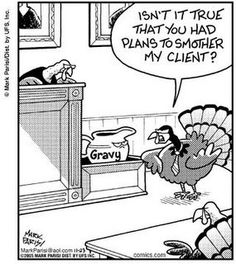
While few lawyers are filing lawsuits the week before Thanksgiving, the holiday does give rise to some interesting cases.  I have compiled a small list of interesting legal entanglements that reference Thanksgiving in one shape or form.  Whether you will laugh or cringe, I am not quite sure, but here they are:

  • Jacobs v. Kent – That unidentifiable form in the bushes making gobbling noises may not be a turkey. Hold your fire!  A couple of guys were hunting for turkeys in New York.  “Defendant’s hunting party had established its position in the woods, and plaintiff’s hunting party entered that area of the woods while looking for an area in which to hunt.  According to defendant, he fired into the dense underbrush after hearing a gobbling sound and seeing a flash of red, and he thereupon discovered that he had shot plaintiff.”  Anyone interested in roasted Jacobs for Thanksgiving dinner?
  • Texas & N.O.R. Co. v. Nolen – If you raise turkeys to be sold around Thanksgiving, you don’t get to recover the turkeys’ Thanksgiving value when they are struck by a train in August.  If your turkeys are killed in August, they get cold-cut value.
  • Silva v. F.W. Woolworth Company – If you choose to eat a Thanksgiving dinner of turkey with dressing and vegetables, you are assuming the risk of choking on a turkey bone. “Bones which are natural to the type of meat served cannot legitimately be called a foreign substance, and a consumer who eats meat dishes ought to anticipate and be on his guard against the presence of such bones.”  Now, what if the turkey dinner had a fish bone lodged in it?  Would that require a different analysis?
  • Greenberg Smoked Turkeys, Inc. v. Goode-Cook, Inc. – The plaintiff, a seller of turkeys, posted serving instructions on its website. The defendant, a competitor, copied the instructions and posted them on its own website.  The plaintiff sued for copyright infringement.
  • Knight v. Merhige – Fair warning, this one is a little creepy. “These appeals arise from a tragic event—Michael and Carole Merhige’s 35-year-old son, Paul, shot and killed family members at a Thanksgiving gathering in Jupiter, Florida. Following the shooting, representatives of the victims’ estates sued the Merhiges, collectively alleging negligence.”  Apparently, Paul had a history of irrational violence and was not generally welcome at large family gatherings.  This history included being involuntarily committed on three occasions and a failed suicide attempt (he survived shooting himself in the chest).  Paul’s parents, knowing that he had quit taking his meds, thought a visit with family for Thanksgiving would raise his spirits.  Despite these hopes, there were some concerns:

In the moments before the Thanksgiving dinner, appellee Carole Merhige expressed concern regarding Paul’s attendance. In one instance, she told an unnamed witness that she hoped Paul “would not kill everyone” at the dinner party. Likewise, she told her daughter, Lisa, “I hope he [Paul] doesn’t come and kill us all tonight”; Lisa responded by telling her mother not to tell her father because he “would get upset that [they] had such ideas.”

The resulting massacre isn’t something that I want to describe.  Ultimately, the lawsuit was dismissed upon the finding that the Merhiges had no legal duty to control the actions of their emancipated son.  The appellate court upheld the dismissal.  You thought your family was crazy.

  • Georgia v. Bartels and Marsh – You may have heard about this one from a couple of years ago. This fine, upstanding Georgia family decided to give their seven (yes, 7) children tattoos for Thanksgiving.  Only six of the seven received tattoos; apparently the parents decided the 10-year-old would have to wait until next Thanksgiving, when he was older.  These misguided parents were charged with cruelty to children, reckless conduct and… wait for it… tattooing without a license.
  • Florida v. Smith – Junior Smith stuffed the turkey the wrong way.  His daughter-in-law was pretty upset about it.  Junior used some choice words to describe his daughter-in-law, and his son was bound to defend her honor.  It was during the ensuing fight, which poured into the children’s room, that the mother-in-law decided to rearrange the daughter-in-law’s hair and face.  The grandparents spent the rest of Thanksgiving in jail.
  • In re Jean Kasper – Family accidentally had their grandmother for dinner. Apparently the recently deceased’s ashes got into the Thanksgiving mashed potatoes.  “I don’t think that is pepper!”

As with most of my blogs, I obtained my information from a variety of sources, but I found THIS ONE particularly helpful.  I trust that this post was entertaining and that it has no adverse effects on your Thanksgiving.  If you know of any additional Thanksgiving related lawsuits, please add them in the comments below.  Maybe I will use them next year.

Read more

AMENDMENTS TO TEXAS HOA LAW FINALLY GIVE HOMEOWNERS A STICK TO FIGHT BACK WITH

HOA Texas

Recent changes in the law finally give Texas homeowners a stick to fight back against abusive practices by Texas homeowners associations.  If you are reading this, you’ve no doubt heard of HOA horror stories. Perhaps you’ve been a victim of HOA harassment or bullying.  HOAs are not regulated by the state or federal government. They are often formed as “non-profit” corporations and claim to be “self-governing entities,” but all too often they act more like private governments, claiming the power to tax, have a police force, impose regulations, and dictate zoning. They’ve often treated their members unfairly and even illegally and gotten away with it.  Common examples include:

  • Arbitrary or personally motivated enforcement actions;
  • Making serious decisions outside of an open meeting;
  • Assessing fines or sanctions without due process;
  • Failure to provide proper notices;
  • Failure to permit inspection of books and records;
  • Breaches of fiduciary duty by Board members;
  • Wrongful foreclosure actions;
  • Filing lawsuits to cover their wrongful actions;
  • Attempts to restrict the display of flags or religious items

             Because of the disparity in financial resources available to support legal actions, individual homeowners have always been at a serious disadvantage in disputes with their HOA. Essentially, the Board members are never required to use their personal funds in legal disputes with individual homeowners. The HOA uses your dues to fund their actions against you.  Homeowners, on the other hand, must use personal funds to pay their own legal expenses. Faced with this economic reality, homeowners, as a practical matter, often have no way to fight back.  In that regard, the HOA laws have historically failed, and failed miserably.

            Fortunately for Texas homeowners, things have gotten much better.  The Texas legislature has begun to level the playing field by making changes to the HOA laws, some of which only went into effect on September 1, 2015.  While not perfect, the HOA laws now give homeowners more rights which will often enable them to stop HOA abuse.

            If you believe your HOA has treated you unfairly or not acted properly in any manner, you owe it to yourself to contact an attorney with experience in this area to discuss your specific situation.  With the changes in the law, it is now much more likely that something can be done to change your situation for the better.

Read more